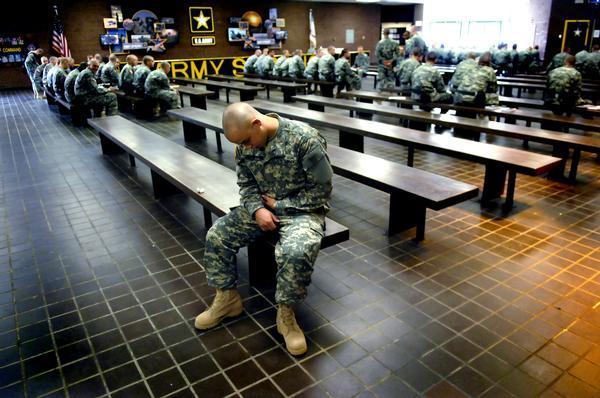
I joined the United States Army in June 2007. With the encouragement of my recruiters, I lied about my pre-existing health conditions. When those conditions became known at Basic Combat Training in Fort Benning, Georgia, I was placed in Echo Company, a waiting station for potential discharges. The following is an excerpt from a memoir, tentatively titled Brokedick, that I’m writing about that time.
Walters
Walters was schizophrenic. He was ill. I don’t know why I’m still able to so easily visualize him. Starting from his enormous Adam’s apple his face began its rise. The Adam’s apple was set into relief by the thinness of his neck. He had no chin. His nose was an obtuse triangle that seemed to proceed in steady elevation from his pronounced overbite. His eyes were brown and I’d swear to that. I can’t otherwise describe them though. He had a scar that began on his forehead and ran back into his hair and upon this scar, no hair would grow.
He was thin, a collection of kindling. He was unmedicated, of course.
I think we were all afraid of him though we didn’t know why. I don’t think he ever assaulted anyone. I know that for some of the guys Walters was a source of semi-sexual fascination. They would rub his head with ferocious affection, as though the bristles of his buzzcut afforded some kind of pleasure. As far as I know, no one ever attempted to try anything with him. If anyone ever bungee-corded him to his bunk, I never heard about it (see notes at bottom).
I usually ended up pulling fireguard (night patrol in the barracks) with Walters. More often than not we would stay awake by sitting at a desk near the door to the latrines and talking about the back issues of National Geographic we’d found in one of the drawers. Mostly astronomy. During the day Walters seemed to be perpetually chuckling or on the verge of saying “Aw shucks” but in the middle of the night he was different. He was still and quiet. He was, like most of the guys in Echo aside from myself, seventeen years old.
A few times we had the 0300-0400 fireguard shift and were tasked with the job of waking up Echo Company. Normally this was done with the sudden, gut-stabbing brightness of all the overhead fluorescent lights turned on at once accompanied by shouts of, “Wake up! Wake the fuck up! Wake the fuck up!” while someone went around with a metal pole, whacking the frames of the bunk beds. I was incapable of that sort of jackassery and bravado. Maybe the saltpetre (see notes at bottom). I also just didn’t have the voice for that kind of hyper-masculine bellowing.
Walters’ voice was adolescent, in a way, but he could project it. I can still see his mouth exploding open, spittle flying, as he hit the lights. It cracked as he yelled but he managed it.
My first memory of Walters, though, is of his laceless combat boots and his bright orange roadguard vest. He was on suicide watch.
Suicide Watch
Being in Echo Company brought with it pariah status. As one commenter on the Internet mentioned:
“Unless you’re a POG [piece of garbage] drill sergeant or an Echo Company loser washout, 30th AG isn’t a duty station for anyone.”
When I was still in Alpha Company, being held over while the rest of the guys I arrived with went downrange, I was made aware of Echo Company. Echo Company was a threat. If you landed in Echo Company you would never leave Fort Benning and you would also be a legitimate target for…anything.
Being on suicide watch while in Echo Company was another level of humiliation. Soldiers who’d attempted or threatened suicide lost their bedsheets, bootlaces, belt, and were required to wear a bright orange vest and, as noted by Elspeth Reeve in 2011:
“On an Army base, where everybody is wearing the same digitized camouflaged uniform—and everybody is trained to spot small differences, like rank and unit, from a distance—just wearing boots held together by rubber bands instead of laces would draw attention. But a road guard vest is bright, construction-zone orange. In a sea of green, you can’t miss it.”
Soldiers on suicide watch were the perfect verbal and sometimes physical punching bag. They were kept apart from formation during marches and their loose boots flopped ridiculously, making them look like Depression-era hobos. For Alpha, Bravo, and Charlie Company, the Echo Company suicide watches embodied all things unmanly, pathetic, and weak. We were all wash-outs from the Army but soldiers on suicide watch had the special distinction of being wash-outs from life.
Soldiers on suicide watch were never alone. Eyes followed them wherever they went. There was no solidarity in the 30th AG. The companies were formalities rather than permanent structures. They were invisible fences to keep some semblance of order in the chaos that was reception. All the humidity-fueled sexual anger of the American male was crushed into 200 foot by 60 foot, two-storey barracks with roughly 50 bunks per floor. This anarchic, compact cauldron of anxiety needed a focus. Hajji (see notes at bottom) didn’t live in the sands of Fort Benning. There were no women. There was only Echo Company and, lower than Echo Company, the soldiers on suicide watch.
- Bungee cording – a practice during which a soldier would be bound to his bunk with bungee cord and sexually assaulted during the night
- Saltpetre – popular myth suggested that our Powerade was laced with salpetre to prevent “morning wood” – if you need “morning wood” explained to you then I’m sorry, nope
- Hajji – slang for Arabs/Middle Easterners
 An Unhappy Consciousness
I found this piece riveting. My experience was sort of like listening to “War of the Worlds” when it first came out. I wanted to escape, and feared I couldn’t. Is this real? This is real! I scrolled through your other posts and about page and calculated, sort of, that this had to be literary fiction. Or is it?
Whatever, it is no less real.
I’m following you, Mr.
LikeLiked by 1 person
I appreciate the comment. I do have a background in creative writing and literature but this is all real. Some of it is pulled from memory and some from scraps of paper, notebooks, etc. that I kept while at Benning. I shipped to basic not long after graduating from undergrad. It was contrarian and reckless of me and I paid for it.
LikeLike
Well, that makes it even more riveting. Keep sharing your story, Joshua. You have quite a testimony.
LikeLike
Joshua, I see that you subscribed to my old site. I no longer publish there. To follow my latest work, go to delightindisorder.org . Thanks, Tony.
LikeLike