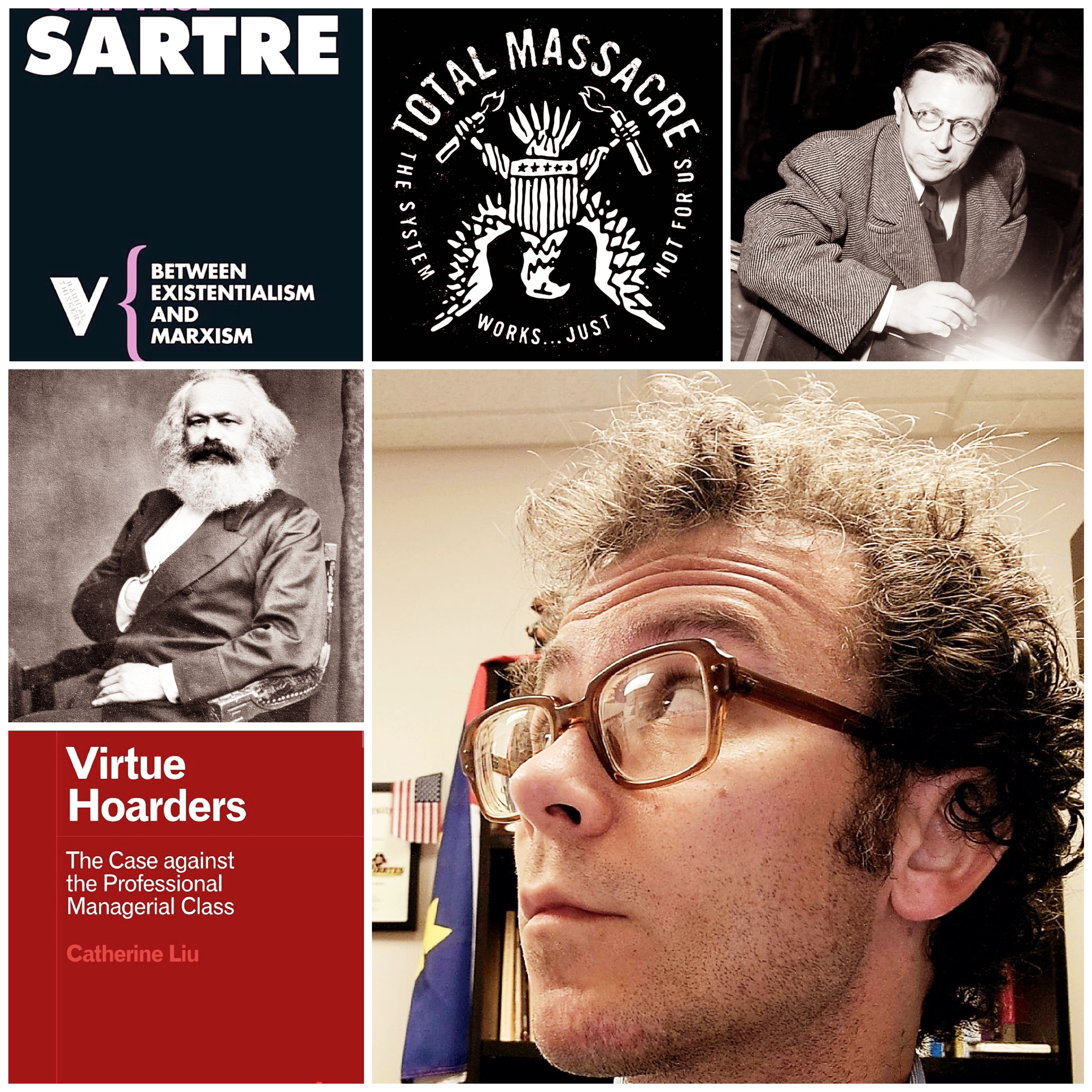
Recently, I was the recipient of a “40 Under 40” award in my community. 40 Under 40 is a feature of many mid-size cities across the United States, and is generally meant to highlight the accomplishments of “young professionals.” On the surface, this is fairly innocuous. Why shouldn’t people be recognized for the work that they do? Yet, in the weeks leading up to the award ceremony, I was more than a little conflicted. The culprit? My unhappy consciousness.
As a community college professor who is also a socialist, I accept that I’m also a member of the Professional Managerial Class (PMC), the strata between the ruling class and the working class. The PMC are the administrators and the credentialed professionals (educators included) responsible for ensuring the generational survival of capitalism and, by extension, continued exploitation by the ruling class. Knowing that I occupy this space, I recognize also that I often indirectly serve the interests of the Department of Defense and Bosses.
So, reading Catherine Liu’s Virtue Hoarders, published 2021, was a pummeling but refreshing experience. Liu, a professor at UC Irvine, points out that “the PMC reworks political struggles for policy change and redistribution into individual passion plays, focusing its efforts on individual acts of ‘giving back’ or reified forms of self-transformation.” This may be her most important observation because it explains both the toothless outcome of the 2020 uprisings and the importance of recognition like 40 Under 40. The former is the result of obscurantism while the latter reinforces the mythology of the individual: both are necessary to the continuation of capitalism in a United States devastated by neoliberalism.
In the universe of the PMC, class does not exist. Even as DEI specialists are hired across the country, there is precious little focus on the material issues that might better explain the instability and fractiousness present in America. What we have instead is an emphasis on identity in a vacuum. It is as though the construct of race is inexplicable rather than an invention born out of a need to justify chattel slavery and to differentiate the enslaver from the enslaved.
This is not to say that race, gender, and other identities do not matter. They do. But without a primary, strong class analysis of our situation, all we end up with is culture war — especially now that our work places seem to be less democratic than ever (particularly in the wake of the pandemic). Race, gender, religion, etc. cannot be properly situated without understanding the concrete conditions that drive so many of us into wage slavery, debt, and despair.
As Liu points out, “As a class, the PMC loves to talk about bias rather than inequality, racism rather than capitalism, visibility rather than exploitation. Tolerance for them is the highest secular virtue—but tolerance has almost no political or economic meaning.” Tolerance is, at best, a neutral state, and there’s likely no point in American history when it would have been sufficient. What the PMC fails to recognize or chooses to forget is that American history is defined by the struggle between the ruling class and those who would expand democracy. It’s important to remember that “whiteness” has never been a static concept, and has been revised to maintain exploitative relationships of property and power.
So, what does this have to do with me? Several years ago, I bought Sartre’s Between Marxism and Existentialism at the college library for a mere 25¢. In writing about the nature of the intellectual, Sartre notes that: “…when one…becomes aware of the fact that despite the universality of his work it serves only particular interests, then his awareness of this contradiction – what Hegel called an ‘unhappy consciousness’ – is precisely what characterizes him as an intellectual.” This struck me so deeply that it inspired the name of this blog, and is never too far from my mind.
The primary focus of my job is to teach English courses. The majority of my students are “non-traditional”, meaning primarily that they are over the age of 30. Racially, religiously, and ethnically diverse, these students tend to find common ground in their material conditions: many are raising children, working full-time, struggling with traumas born of class and combat, and daily living with precarity. Yet none of them will escape the grinding brutality of capitalism simply by earning a credential or degree.
The PMC and ruling class both continue to advocate for the primacy of the individual and the non-profit industry as panaceas. Neither of these will bring dignity to people who live under an economic regime predicated on scarcity and suffering. That is why this blog exists and why I do the research work that I do. Of course, this does not mean that I will cease being a member of the PMC. As Sartre points out, the way for the intellectual to move ahead is to refuse the conditioning of their class and to criticize and radicalize.
With this blog and my extracurricular activities, I hope to “make use of the capital of knowledge” (Sartre) I have acquired from the dominant class and place it in the service of what Sartre calls “popular universalization.” I cannot resolve the contradiction between my class and my intentions nor can I ever be completely assimilated into the struggle of liberation, though Paolo Freire may have something to say about that.
As it is, I’ve said enough. I accepted my 40 Under 40 award with the intention of using that recognition to be of further service to my community. All the while, the words of the band Total Massacre run through my head: “They focus on the individual to obscure the systems that affect us all.”
 An Unhappy Consciousness